Ue4 How Do I Wait for Input to Continue Executing
Github Link: https://github.com/Harrison1/unrealcpp/tree/master/MyPawn
For this tutorial we are using the standard first person C++ template with starter content. If you don't know how to add a new actor class to your project, please visit the Add C++ Actor Class post.
The main logic of this code is from Epic's Unreal Engine 4 documentation's tutorial titled Player Input and Pawns and you can see the full tutorial here.
In this example we will add inputs to a pawn and move it around our game. Create a new C++ actor class and call it MyPawn. In the header file we'll create variables for our 'Axis' movements, functions, and bool. Below is the final header code.
MyPawn.h
# pragma once # include "CoreMinimal.h" # include "GameFramework/Pawn.h" # include "MyPawn.generated.h" UCLASS ( ) class UNREALCPP_API AMyPawn : public APawn { GENERATED_BODY ( ) public : // Sets default values for this pawn's properties AMyPawn ( ) ; protected : // Called when the game starts or when spawned virtual void BeginPlay ( ) override; public : // Called every frame virtual void Tick ( float DeltaSeconds) override; // Called to bind functionality to input virtual void SetupPlayerInputComponent ( class UInputComponent * InputComponent) override; UPROPERTY (EditAnywhere) USceneComponent* OurVisibleComponent; // Input functions void Move_XAxis ( float AxisValue) ; void Move_YAxis ( float AxisValue) ; void StartGrowing ( ) ; void StopGrowing ( ) ; // Input variables FVector CurrentVelocity; bool bGrowing; } ; In editor let's create an Action mapping called Grow and bind it to the G key. Then make two Axis mappings and call them MoveX and MoveY. Set the axis scales to 1 and -1 respectively.
// TODO get images and scales
project settings
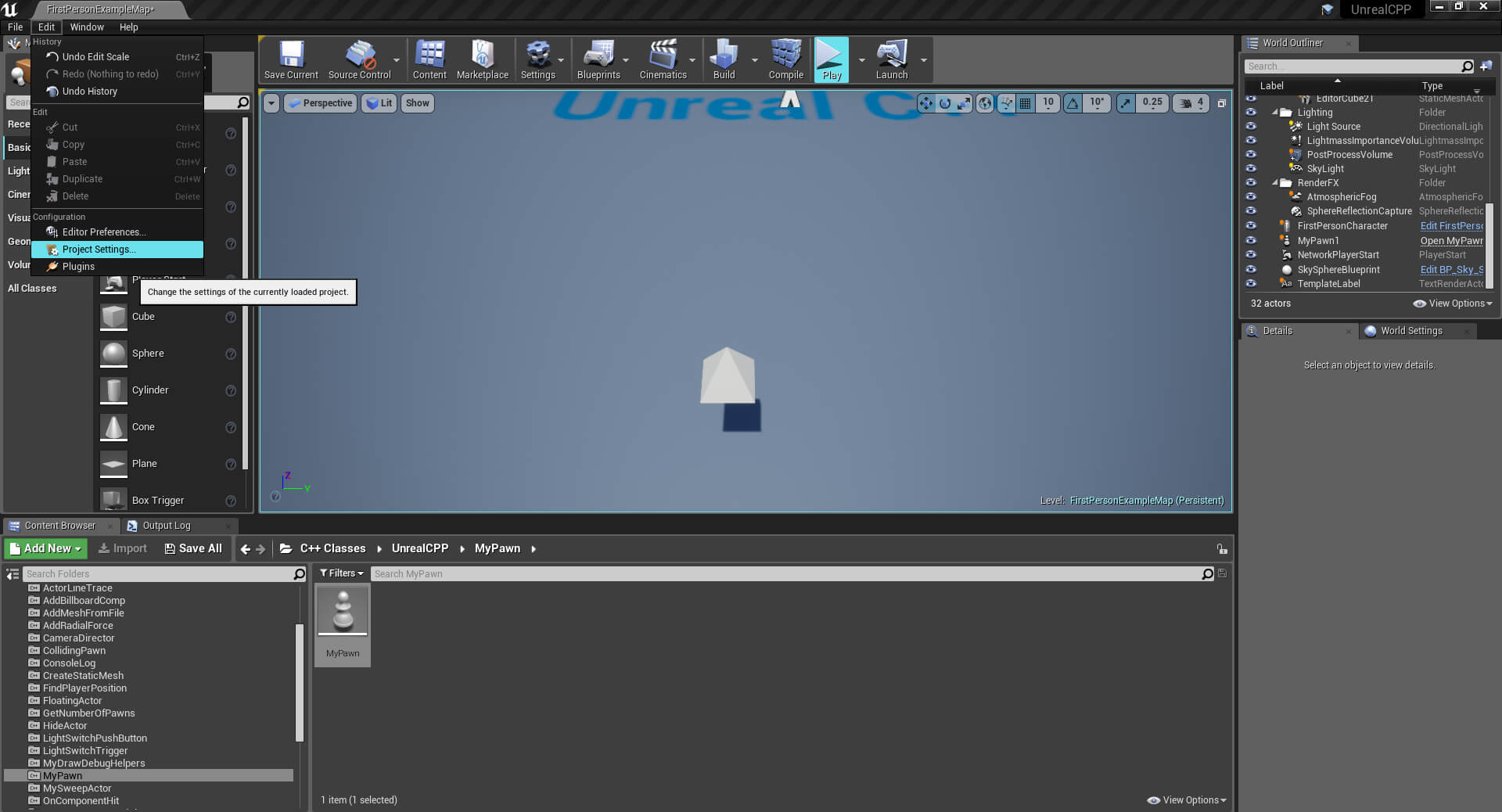
add inputs

-
MoveX
I: Scale 1.0
K: Scale -1.0 -
MoveY
J: Scale -1.0
L: Scale 1.0 -
Grow
G
In the .cpp file make sure to #include Camera/CameraComponent.h, Components/InputComponent.h, and Components/StaticMeshComponent.h.
include files
# include "MyPawn.h" # include "Camera/CameraComponent.h" # include "Components/InputComponent.h" # include "Components/StaticMeshComponent.h" Next, we'll set the default values. First, we want automatically possess the player by doing AutoPossessPlayer = EAutoReceiveInput::Player0;. Next we create and add a visual component and camera to our dummy RootComponent.
set default values
// Sets default values AMyPawn :: AMyPawn ( ) { // Set this pawn to call Tick() every frame. You can turn this off to improve performance if you don't need it. PrimaryActorTick.bCanEverTick = true ; // Set this pawn to be controlled by the lowest-numbered player AutoPossessPlayer = EAutoReceiveInput::Player0; // Create a dummy root component we can attach things to. RootComponent = CreateDefaultSubobject<USceneComponent> ( TEXT ( "RootComponent" ) ) ; // Create a camera and a visible object UCameraComponent* OurCamera = CreateDefaultSubobject<UCameraComponent> ( TEXT ( "OurCamera" ) ) ; OurVisibleComponent = CreateDefaultSubobject<UStaticMeshComponent> ( TEXT ( "OurVisibleComponent" ) ) ; // Attach our camera and visible object to our root component. Offset and rotate the camera. OurCamera-> SetupAttachment (RootComponent) ; OurCamera-> SetRelativeLocation ( FVector ( - 250.0f , 0.0f , 250.0f ) ) ; OurCamera-> SetRelativeRotation ( FRotator ( - 45.0f , 0.0f , 0.0f ) ) ; OurVisibleComponent-> SetupAttachment (RootComponent) ; } In the Tick function we'll want to always check the state of growing for the pawn and always position the pawn correctly. Every frame we get the VisualComponent's scale and if the player is pressing G we will add DeltaTime to the scale. When the key is not pressed, the scale will shrink back to normal size all while clamping it's size so it doesn't go above 2 (double the size) or below 1 (initial size).
Tick function
// Called every frame void AMyPawn :: Tick ( float DeltaTime) { Super :: Tick (DeltaTime) ; // Handle growing and shrinking based on our "Grow" action { float CurrentScale = OurVisibleComponent-> GetComponentScale ( ) .X; if (bGrowing) { // Grow to double size over the course of one second CurrentScale += DeltaTime; } else { // Shrink half as fast as we grow CurrentScale -= (DeltaTime * 0.5f ) ; } // Make sure we never drop below our starting size, or increase past double size. CurrentScale = FMath :: Clamp (CurrentScale, 1.0f , 2.0f ) ; OurVisibleComponent-> SetWorldScale3D ( FVector (CurrentScale) ) ; } // Handle movement based on our "MoveX" and "MoveY" axes { if ( !CurrentVelocity. IsZero ( ) ) { FVector NewLocation = GetActorLocation ( ) + (CurrentVelocity * DeltaTime) ; SetActorLocation (NewLocation) ; } } } Now, let's bind our actions and axes to our functions. We'll create the functions in the next steps.
Bind Input
// Called to bind functionality to input void AMyPawn :: SetupPlayerInputComponent (UInputComponent* PlayerInputComponent) { Super :: SetupPlayerInputComponent (InputComponent) ; // Respond when our "Grow" key is pressed or released. InputComponent-> BindAction ( "Grow" , IE_Pressed, this , &AMyPawn::StartGrowing) ; InputComponent-> BindAction ( "Grow" , IE_Released, this , &AMyPawn::StopGrowing) ; // Respond every frame to the values of our two movement axes, "MoveX" and "MoveY". InputComponent-> BindAxis ( "MoveX" , this , &AMyPawn::Move_XAxis) ; InputComponent-> BindAxis ( "MoveY" , this , &AMyPawn::Move_YAxis) ; } Create two axis functions that will handle moving our Pawn. These functions will clamp movement between 1 and -1 and move us at a rate of 100 unreal units.
axis functions
void AMyPawn :: Move_XAxis ( float AxisValue) { // Move at 100 units per second forward or backward CurrentVelocity.X = FMath :: Clamp (AxisValue, - 1.0f , 1.0f ) * 100.0f ; } void AMyPawn :: Move_YAxis ( float AxisValue) { // Move at 100 units per second right or left CurrentVelocity.Y = FMath :: Clamp (AxisValue, - 1.0f , 1.0f ) * 100.0f ; } Next, we'll create two functions that simply toggle our bGrowing bool.
growing functions
void AMyPawn :: StartGrowing ( ) { bGrowing = true ; } void AMyPawn :: StopGrowing ( ) { bGrowing = false ; } Compile the code. And now drag and drop your newly created pawn into your game and start moving it around.
ballardtheaticand.blogspot.com
Source: https://unrealcpp.com/receive-player-input/
0 Response to "Ue4 How Do I Wait for Input to Continue Executing"
Post a Comment